OpenAI publishes eighth ChatGPT Ads success story, but only Evernote’s says its numbers don’t prove the ads worked

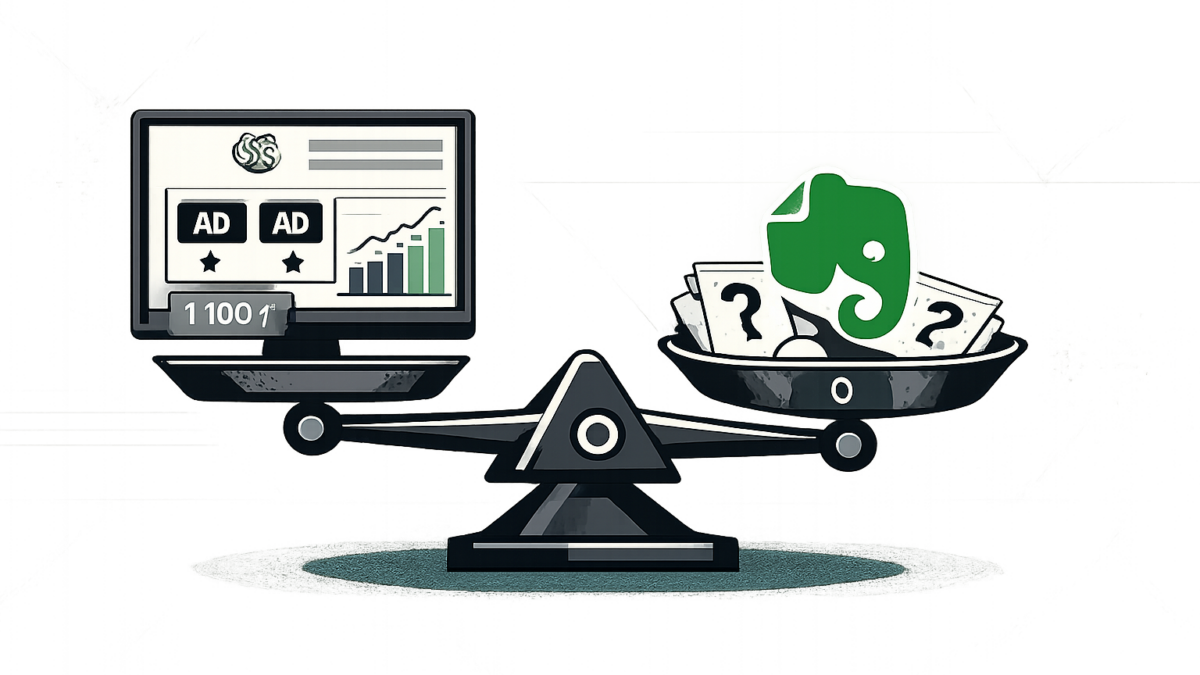
OpenAI has now published eight customer stories for ChatGPT Ads, its advertising product inside ChatGPT. The latest, posted on October 28, says Evernote’s core campaigns turned free trials into paid subscriptions about 10 to 20% more often than the note-taking app’s historical paid-acquisition average. However, a footnote on the same page says “the comparison does not establish incremental lift.”
None of the other seven stories, posted since August 17, carries a similar caveat or describes a holdout group. Five report return on ad spend (ROAS), but each uses a different time window and baseline, and some do not state how they attributed sales to ads.
Evernote described its first-month results as “encouraging and directional”, and said it is still testing whether they hold as the channel grows.
What did Evernote measure?
Evernote reported two figures:
- Trial-to-paid conversion: The share of free trials that reached a first subscription payment. Trials from the ChatGPT Ads campaigns started between August 28 and September 12, 2026. The benchmark trials started between March and August 2026. This means a two-week cohort was compared with roughly six months of history.
- Desktop registration: About 25% of desktop visits from the same campaigns resulted in a new account between September 14 and 28. The page gives no comparison for this figure.
Incremental lift refers to conversions the ads caused, which would not have happened otherwise. A higher conversion rate among people who clicked an ad can also reflect who chose to click. Evernote counted an account as coming from ChatGPT Ads when the user’s first tagged visit came from an ad click, according to its own analytics and subscription records.
As of November 4, the Evernote story did not appear on OpenAI’s customer stories page, which lists the other seven. Evernote said it plans to explore more use cases and build dedicated landing pages.
Can the eight stories be compared?
No. ROAS is revenue divided by ad spend, so 3x means $3 in revenue for every $1 spent. Talkpal said its ROAS uses net revenue. The other stories do not say which revenue figure they used. The stories also use different attribution rules, and the same campaign can score differently under each.
According to OpenAI’s pages:
- Loop Earplugs (October 26): 5.1x ROAS across five product-feed campaigns and 1.8x for a non-feed campaign in the EU, between August 18 and September 8. Loop used post-click attribution, excluding view-through conversions.
- Talkpal (September 22): About 26% higher ROAS and 51% lower cost per trial activation than a native advertising channel it had run for over a year. The ROAS figure uses last-click attribution (June 23 to August 18). The cost-per-trial figure uses pixel and Conversions API events (July 1 to September 9). Both are internal estimates.
- Angi (September 22): ROAS rose more than 38% in Q3 compared with Q2, and cost per lead fell 34%. Both figures compare Angi with its own earlier ChatGPT Ads results. The page gives no dates or attribution method.
- Jotform (September 3): Cost per signup was 60% lower than paid social and 30% lower than paid search in July 2026. The page does not state an attribution method.
- LegalNature (September 3): About 40% of visitors started a document and about 8% completed one, between July 1 and August 23, using last-click attribution. The page gives no purchase or revenue figure.
- Stream (September 1): 2x ROAS on a developer-skills campaign between June 5 and August 5, with about $10,000 spent per test group. The page does not state an attribution method.
- Newegg (August 17): 3x ROAS over 28 days and 7x during a two-week sale. The page gives no dates or attribution method.
All figures come from the advertisers’ own data. OpenAI published them on sales pages that end with an “Advertise in ChatGPT… Start now” button.
Which campaigns performed best?
Specific ones, according to two of the advertisers:
- Loop: Loop said campaigns built around a concrete use case returned more than those built around broad intent. It used “festival earplugs” versus “earplugs” to illustrate the difference. “Our reading is that it matches how people actually use ChatGPT. Someone describes a situation, not a product category, so a campaign built around a situation has something to connect to,” said Gijs Koch, Loop’s manager of search marketing.
- LegalNature: LegalNature said its strongest campaigns were its most specific. An ad about a power of attorney sent users directly to a power-of-attorney page.
Two others point in the same direction, without a head-to-head test. Jotform said optimising landing pages for its use-case campaigns increased its signup rate 2.5x. Stream said developer prompts often read “more like working briefs” than keyword searches.
What this means for AEO
In my view, organic answer engine optimisation works the same way. People describe a situation to ChatGPT, and a page that answers that situation gives the model something to match. A category page does not. Brands whose paid teams build a “festival earplugs” campaign should build an organic page for the same situation, and get it into the third-party comparisons that cover it, since models discount a brand’s own page on competitive queries.
ChatGPT shares no organic search data with publishers or brands. On the paid side, the only performance numbers available are the ones advertisers chose to publish.
Questions the eight stories leave open
- Did the ads cause the conversions? Apart from Evernote’s footnote, no story addresses incrementality.
- What are typical results? None of the eight pages gives a cross-advertiser average for ROAS, cost per click or conversion rate.
- How much did advertisers spend? Only Stream gives a spend figure. Loop said it raised daily spend about two and a half times, but did not give the starting level.
- How many advertisers tested ChatGPT Ads and did not get a story? OpenAI has not said.
- Will Evernote report whether its first-month rate held, and will any advertiser publish a holdout test?
Sources
- OpenAI, “Evernote turns AI-driven discovery into paid subscriptions” (October 28, 2026): https://openai.com/ads/customers/evernote
- OpenAI ChatGPT Ads, “Loop Earplugs builds on early success with product-feed ads” (October 26, 2026): https://ads.openai.com/customers/loop
- OpenAI ChatGPT Ads, “Talkpal grows ChatGPT Ads into a top acquisition channel” (September 22, 2026): https://ads.openai.com/customers/talkpal
- OpenAI ChatGPT Ads, “Angi scales efficient lead growth reaching homeowners in ChatGPT” (September 22, 2026): https://ads.openai.com/customers/angi
- OpenAI ChatGPT Ads, “Jotform builds a new discovery and acquisition playbook” (September 3, 2026): https://ads.openai.com/customers/jotform
- OpenAI ChatGPT Ads, “LegalNature turns conversational intent into completed legal documents” (September 3, 2026): https://ads.openai.com/customers/legalnature
- OpenAI ChatGPT Ads, “Stream turns developer questions into qualified pipeline” (September 1, 2026): https://ads.openai.com/customers/stream
OpenAI ChatGPT Ads, “Newegg reaches PC builders with product feed ads” (August 17, 2026): https://ads.openai.com/customers/newegg