How Google Search is changing to AI search, and how newsrooms need to change their writing


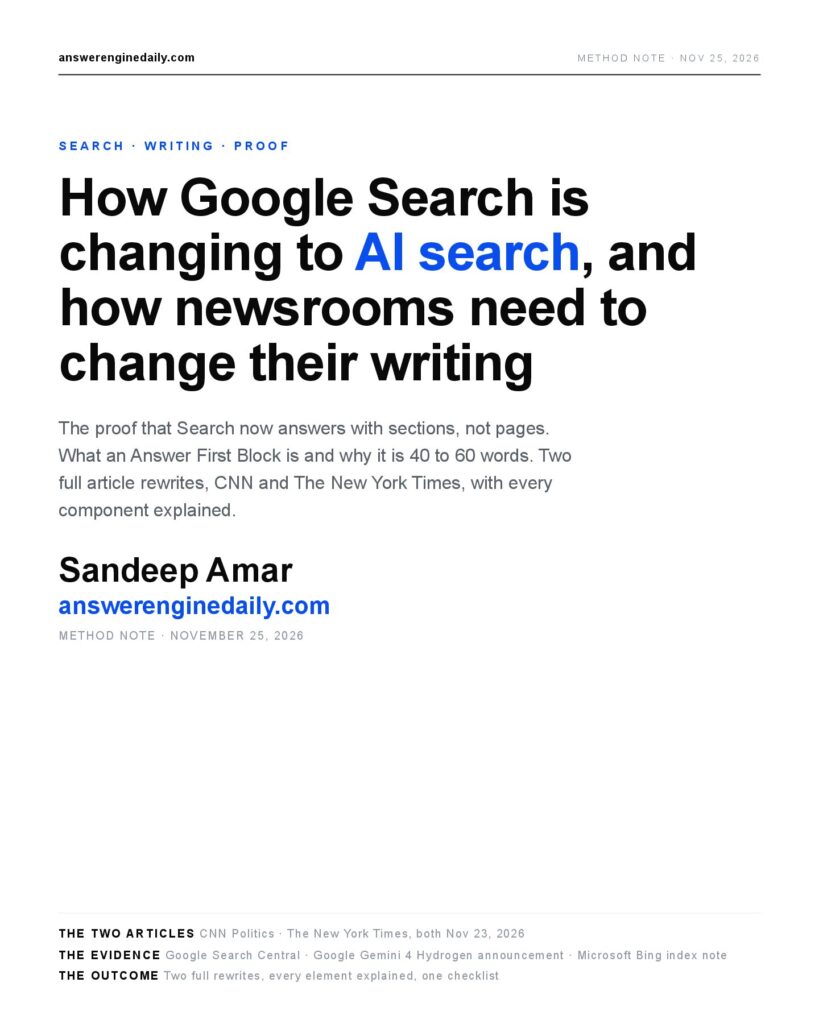
A 56-page method note by Sandeep Amar, published November 25, 2026. It shows, from Google’s own announcements, that Search now answers with sections of pages rather than whole pages. It explains how newsrooms should write for this using the Answer First Block (AFB), and rebuilds two November 23 articles, from CNN and The New York Times, in full.
Search became an answering engine
The report traces the shift through five dated Google announcements: AI Overviews in 2024, AI Mode testing in March 2025, the US rollout of AI Mode in May 2025, one billion monthly AI Mode users in May 2026, and Gemini 4 Hydrogen in Search for all users on November 12, 2026. Google calls Hydrogen “the biggest model upgrade to Search yet.”
Hydrogen strengthens query fan-out, where Google splits one question into several background searches and builds one answer from the passages it finds. Because the AI layer selects sections, not pages, a newsroom now has two jobs on one page: be worth visiting, and be quotable section by section. The report also makes clear that Search still ranks pages and SEO fundamentals still apply.
The method
The report defines seven elements of an article in this format: an H1 written as a claim, a 40 to 60 word lead AFB, five to eight descriptive H2s, a short answer block under each H2, H3s only where a section truly splits, evidence placed after the answer, and end matter with a dated Background, Questions left open and References.
It takes the AFB apart in detail: the formula (who, what, where, when, key number), eight rules, six common failures, and why the range is 40 to 60 words. It then shows how to assemble the whole article, with an eight-step build order, a lift test for every block and a nine-point filing gate.
Two articles, rebuilt in full
The CNN and New York Times stories on Jensen Huang’s reinstatement as Nvidia’s chief executive are each rewritten in the format. Each comes with the lead block marked component by component, the complete rewritten article, and a table explaining every change. A side-by-side comparison shows how the same structure carries two different stories and voices.
What newsrooms can take away
The report closes with a six-line summary of the argument, a 16-point checklist, a design for a one-quarter pilot with a control group, four stated limits, a glossary and the full source list.
For: Editors, reporters, desk heads and SEO teams at news publishers.